


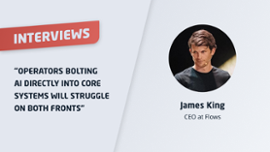
Flows has recently broken ground in Pennsylvania, how important a milestone is this for you? Pennsylvania is a hugely important milestone. It's a mature, competitive regulated market and exactly the environment where the way we built Flows starts paying off, where operators are running across multiple platforms, suppliers and player touchpoints, and where they need to move faster than the development cycles allow. That's the problem we've spent years solving. With our recent launch of Flo, our AI brain on top of the Flows orchestrator, Pennsylvania operators now have the orchestration layer and the intelligence sitting on top of it, both in one place. That's a different conversation than the one happening here a year ago. Do you see room for growth in the iGaming market in the United States at a time when online casino regulation has more or less stalled? There's still huge room for growth. Even where new state regulation has slowed, the operators already live are under real pressure to compete harder, differentiate more sharply and operate more intelligently inside complex tech stacks. That's where the opportunity is now, not in counting new states, but in helping the operators in existing states unlock genuine operational depth. The next phase of US iGaming will be won by businesses that can adopt new technology, including AI, at the pace the market actually moves. That's not a development capacity problem, it's an orchestration problem and it's exactly where Flows sits. Are companies turning to your no-code solution, or is there still some skepticism when it comes to adoption? The no-code conversation has moved on. Operators today aren't really asking whether they can build without developers, they're asking whether they can adopt the new wave of AI tools safely inside a regulated, real-time, multi-market business. That's a much harder question, and it's why Flows has become an orchestration layer rather than just a no-code tool. We connect systems, coordinate data and let operators build, launch and improve products and experiences across the stack, without touching the core or waiting in a dev queue. With the launch of Flo last month at iGaming NEXT Valletta, that capability now has an AI brain on top of it. You have a conversation with Flo, it understands your role, your market and your business, it reads what's already running, and it builds. It's the difference between bolting AI onto a product and having it sit as a layer across everything you do. What do you think is your biggest competitive advantage in the iGaming market in Pennsylvania? Our biggest strength is that Flows isn't trying to solve one isolated part of the operation. We're the orchestration layer across the whole business, connecting the systems that traditionally don't talk to each other and letting operators build and launch products, features and experiences faster across gamification, jackpots, loyalty, omnichannel engagement, CRM and operational workflows. With the launch of Flo, that capability now thinks alongside you. Flo is a team in one conversation, your consultant, your product manager, your developer, your QA. It reads what's already running, sees how it's performing, and helps you decide what to build next, then builds it. For Pennsylvania operators specifically, that's a meaningful shift. It means a smaller team can do the work of a much larger one, and it means AI adoption stops being a separate project and becomes part of how the business actually operates. 5. How do you see the role of regulatory clarity evolving in the US and what would need to change for more states to accelerate online casino adoption? Greater regulatory clarity will help, but the more interesting shift is happening around how operators run inside the regulation that already exists. Responsible gambling, transparency, real-time oversight, audit trails. These are all becoming more demanding, not less. As more AI gets adopted across operations, regulators will increasingly want to see that AI-driven decisions are deterministic, auditable and explainable. That sits in the orchestration layer, not in the AI itself. Operators with strong orchestration underneath them will be best placed to adopt AI quickly and pass audits cleanly. Operators bolting AI directly into core systems will struggle on both fronts. 6. Looking ahead to 2026 and beyond, what are the biggest priorities for Flows as you continue expanding in the US market? Three priorities. First, continuing to strengthen the orchestration engine itself. We're processing over 600 million real-time events a day across gaming and that infrastructure has to keep getting faster, more reliable and more deeply integrated as the industry's complexity grows. Second, evolving Flo. We've just launched V1 and we're already deep into V2, expanding the read-write capability across more systems, deeper KPI-driven recommendations, and tighter integration with the AI tools and agents operators have already built themselves. Third, the US specifically. Pennsylvania is the start of a much bigger expansion plan for us in this market, and the operators here are exactly the kind of business Flows was built for. Complex, ambitious, regulated, and ready to move faster than the development queue allows. Drag and drop files or click here to upload. We could not recognize in which language did you write your reply. Please choose your language from following options Your post has been sent to forum admins for a review to make sure it meets our community guidelines. You will receive an e-mail about the outcome of this process within 48 hours.









Comments
No comments yet.